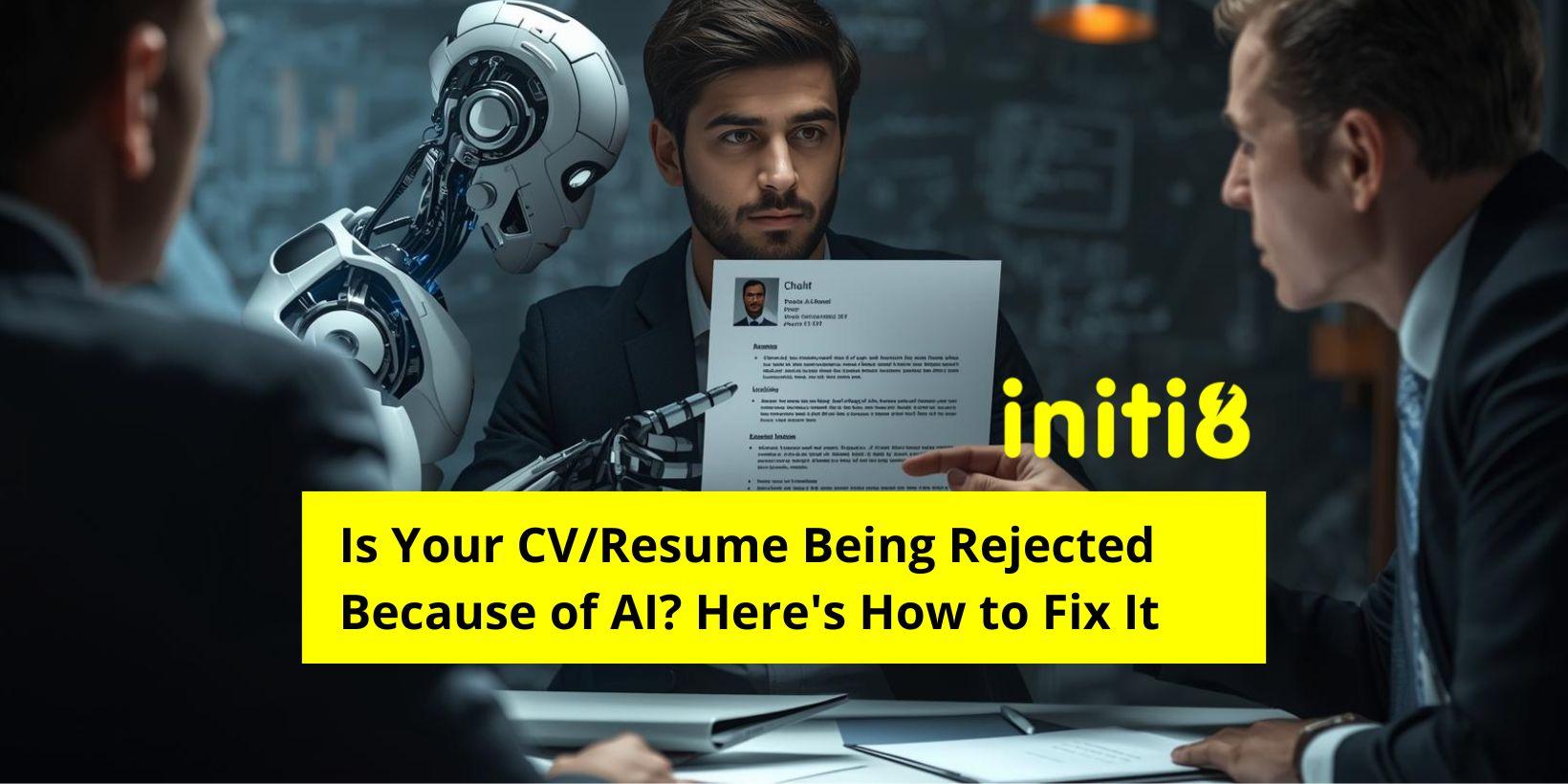
Will using AI to write my CV automatically get me rejected by recruiters?
The first thing to understand is about something we call AI Fatigue when hiring. When every candidate sounds "exceptional" and "visionary" because they've used the same AI prompts, nobody really stands out.
In the Tech/IT sector especially, where technical proof is paramount, generic AI-generated text has pretty much become the fastest route to the rejection pile.
Recruiters can now spot AI-written content within seconds, and they're more than likely actively filtering it out. While we recommend crafting your CV/Resume by being your authentic self, we understand AI can be used as a tool to help those in need, but it shouldn't be used as a cheat code.
Jerome Ternynck, Founder & CEO of SmartRecruiters (Enterprise hiring software)
"The frictionless application process, combined with AI assistance, has created a tsunami of candidates. But more candidates does not mean better hiring; it often leads to 'analysis paralysis' and recruiter burnout."
Remember, most people are using AI now so it's best to use it strategically whilst ensuring your CV or Resume remains authentically human and evidence-based.
How do I stand out when everyone else is using the same AI Resume/CV templates?
The Problem: AI is great at creating perfectly polished summaries of your responsibilities but as we all know is open to hallucination, or it could generalise specific outcomes. When everyone's CV/Resume reads the same, recruiters cannot distinguish genuine expertise from fabricated claims.
Gartner (HR Research Practice)
"As candidates increasingly use GenAI to tailor resumes and cover letters, recruiters face a 'validity crisis.' The fatigue comes not just from reading resumes, but from the inability to trust that the document reflects the person."
Someone once said on X: "When everyone is Super, no-one is".
The Solution: Either be human (your authentic self) or focus on formats that highlight real evidence over adjectives, using measurable outcomes and achievements that can actually be verified rather than the usual fluffy language.
Format 1: The Hybrid-Evidence Format
What is the Hybrid-Evidence Format?
The Hybrid-Evidence format builds upon the traditional reverse-chronological structure. This is still the safest option for Applicant Tracking Systems (ATS) but adds a crucial "Key Projects & Impact" section that AI cannot easily replicate.
Why Does This Format Work?
This approach forces candidates to provide real life hard data, and specific technical details that AI cannot invent. It separates those who have genuinely done the work from those relying solely on AI generation.
How Should You Structure This Format?
Header Section:
- Include your typical contact information
- If possible add clickable links to your portfolio or GitHub profile (if you have one)
- Ensure all links are current and showcase real work
The Human Summary:
- Write a 3-sentence summary entirely yourself
- Display genuine personality and career intent. Be yourself.
- Avoid AI-generated phrases, especially the ones recruiters are trained to spot.
- Write how you would actually write, but keep it professional.
Technical Skills (Categorised):
- Languages
- Frameworks
- Cloud platforms
- DevOps tools
Featured Projects (The AI-Proof Section):
For each project, include:
- Project Name: Clear, descriptive title
- Tech Stack Used: Specific technologies and versions
- The Human Challenge: Describe the genuine problem (e.g., "We needed to scale from 1,000 to 100,000 users within one week")
- The Outcome: Provide measurable results (e.g., "Reduced latency by 40%")
Professional Experience:
- List in reverse chronological order
- Focus on achievements rather than duties
- Include specific metrics wherever possible
Format 2: The De-Fluffed Functional Format
What is the De-Fluffed Functional Format?
Historically unpopular with recruiters, the functional format is experiencing a renaissance for senior IT professionals (Architects, CTOs) because it cuts through the narrative fluff that AI tends to overwrite.
Why Does This Format Work?
It focuses purely on competencies and prevents AI from writing lengthy, flowery paragraphs about roles held years ago. It provides instant clarity and directness.
What Strategy Should You Follow?
Instead of asking AI to "write a description for my role," use AI to "extract key technical keywords from this job description and match them to my list of proven competencies."
How Should It Look?
- Bold Headers: Use large, clear headers for core competencies (e.g., Cloud Migration, Cybersecurity Governance)
- Bullet Points: Under each competency, list specific instances where and when you applied those skills
- Evidence-Based: Each point should reference tangible projects or outcomes
How to Use AI as a Co-Pilot, Not the Pilot
What's the Most Common Mistake with AI?
Candidates ask AI to "write the entire resume." This produces generic, easily-spotted content that recruiters immediately reject.
What Should You Use AI For Instead?
The Gap Analysis Prompt:
Bad Approach: "Write a resume based on this job description."
Good Approach: "Here is my current CV draft and here is the target job description. Act as a cynical IT recruiter. Tell me exactly what technical skills or certifications are missing from my CV that would cause you to reject me."
The Bullet Point Sharpener Prompt:
Bad Approach: "Make this sound professional." (This produces generic buzzwords)
Good Approach: "Here is a rough bullet point: 'I fixed a bug in the code.' Rewrite this to be action-oriented using the XYZ formula (Accomplished [X] as measured by [Y], by doing [Z]), but keep the tone neutral and factual. Do not use words like 'spearheaded' or 'visionary'."
Red Flags to Avoid with AI
What are the specific 'tells' that reveal my resume was written by ChatGPT?
The Regenerate Structure:
- Bullet points that are all exactly the same length
- Every point follows identical grammatical structure (Verb-Adjective-Noun)
- The overall appearance looks robotic and template-driven
The Vocabulary of 2025 AI:
Words that Large Language Models overused in the mid-2020s trigger immediate scepticism:
- "Unwavering"
- "Tapestry"
- "Delve"
- "Synergy"
- "Foster"
What Words Should IT Professionals Use Instead?
Recruiters want to see action-oriented technical language:
- "Deployed"
- "Configured"
- "Debugged"
- "Architected"
- "Optimised"
- "Migrated"
Generic Soft Skills Without Context:
AI loves listing "Critical Thinking" and "Problem Solving" without evidence. In IT, you prove problem-solving by describing a specific outage you fixed, not by listing the skill by itself.
Verification is the New Standard for 2026
In an age where AI can fabricate experience convincingly, verification has become the ultimate differentiator.
How Can You Provide Hyperlinked Evidence?
Treat your CV as a portal. Every major claim should, where possible, link to:
- GitHub repositories
- Published papers or articles
- Live applications or websites
- Verifiable certification badges from recognised platforms
Have you tried Video Introductions?
A rising trend in 2025 and for 2026 involves creating and linking a 60-second Loom or video where you discuss your code or a specific project. This proves a few things:
- Communication skills
- Technical knowledge
- Authenticity
Good vs Bad Examples: The Critical Comparison
Professional Summary Examples
Bad Example (Typical AI Output):
"A highly motivated and visionary IT professional with a passion for leveraging cutting-edge technology to drive organisational synergy. A dynamic team player with a proven track record of excellence in software development, dedicated to fostering innovation and delivering robust solutions in fast-paced environments. I am thrilled to bring my unique blend of technical expertise and soft skills to a forward-thinking company."
Why Recruiters Reject This: Uses 45 words to say nothing. Terms like "visionary," "synergy," and "thrilled" represent hallucinated enthusiasm. It mentions no specific tech stack or role.
Good Example (Human/Hybrid Edit):
"Senior Full-Stack Developer with 7 years of experience specialising in FinTech applications. Expert in migrating legacy Java monoliths to microservices using Spring Boot and AWS Lambda. Recently led a team of 5 developers to reduce deployment latency by 40% through CI/CD optimisation. Seeking to leverage scalable architecture experience in a high-volume trading environment."
Why This Wins: Dense with keywords (Java, Spring Boot, AWS) placed in context. States seniority, industry focus (FinTech), and a specific metric (40% reduction).
Work Experience Bullet Point Examples
Bad Examples (Typical AI Output):
- "Responsible for managing database systems and ensuring data integrity across the organisation."
- "Collaborated with cross-functional teams to brainstorm and implement effective coding strategies."
- "Utilised Python to analyse data and create reports for management review."
Why Recruiters Reject These: They describe duties, not results. Anyone hired for that role would be "responsible for" these things. The language is passive and unquantified.
Good Examples (Human/Hybrid Edit):
- "Designed and maintained a PostgreSQL database supporting 5TB of customer data; implemented sharding strategies that improved query response times by 200ms."
- "Partnered with Product and QA teams to introduce TDD (Test Driven Development) protocols, reducing production bugs by 15% in Q3 2024."
- "Built automated Python scripts (Pandas/NumPy) to scrape competitor pricing, saving the marketing team 10 hours of manual entry per week."
Why These Win: They follow the "Action + Tool + Result" formula. They prove you didn't just use Python—you used it to solve a specific business problem.
Skills Section Examples
Bad Example (Typical AI Output):
Skills: Python, Java, AWS, Docker, Kubernetes, Communication, Leadership, Problem Solving, Critical Thinking, Time Management.
Why Recruiters Reject This: Listing "Problem Solving" creates irony—it gives recruiters a problem because they don't know how you actually use these tools. Soft skills are unproven.
Good Example (Human/Hybrid Edit):
Technical Skills:
- Languages: Python (Automation/Scripting), Java (Enterprise Backend), Go (Microservices)
- Cloud & DevOps: AWS (Certified Solutions Architect - Associate), Docker & Kubernetes (Managed clusters for 3 production apps)
- Databases: MongoDB (NoSQL), PostgreSQL (Complex joining/indexing)
Why This Wins: Adds parenthetical context. Tells recruiters specifically where your expertise lies within each technology.
What's the Golden Rule for 2026 CVs and Resume's?
The most effective CV or Resume format in the Age of AI prioritises high-density information over narrative flow. It uses AI to optimise keywords for machines (ATS), but relies on human-verified data and specific metrics to persuade human recruiters.
What Should Your Strategy Be?
- Use AI for analysis, not generation
- Provide evidence for every major claim
- Focus on metrics and measurable outcomes
- Link to verifiable work (GitHub, live projects, certifications)
- Write your summary yourself to inject genuine personality
- Avoid AI buzzwords that trigger immediate rejection
- Structure for clarity, making technical proof immediately visible
What's the Ultimate Test?
What's the Ultimate Test?
If a recruiter cannot immediately identify your specific technical expertise and measurable impact within 10 seconds of looking at your CV or Resume, it needs revision.
Standing Out in a Sea of Sameness for 2026
AI fatigue is real, and it's changing how recruitment works. The candidates who will succeed in 2026 aren't just those who avoid AI entirely, but those who will use it strategically whilst keeping their own voice, genuine experience, and verifiable achievements at the forefront.
Your CV or Resume should tell your story, the one that only you can tell, backed by evidence that only you can provide.
That's how you cut through the noise and land the interview.
Author
Initi8
Date
13 January 2026